Posts

Showing posts with the label 2nd degree block type II

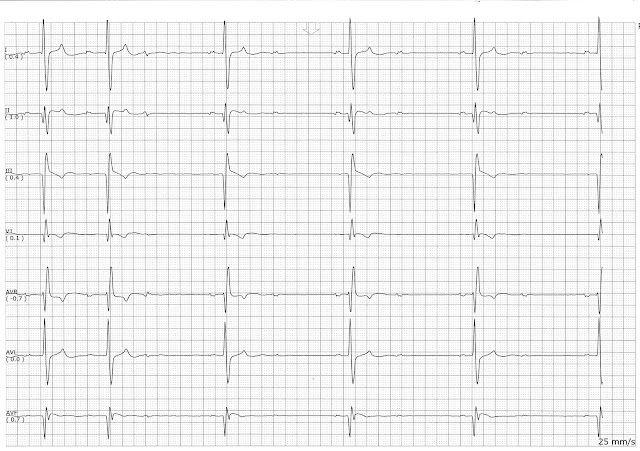
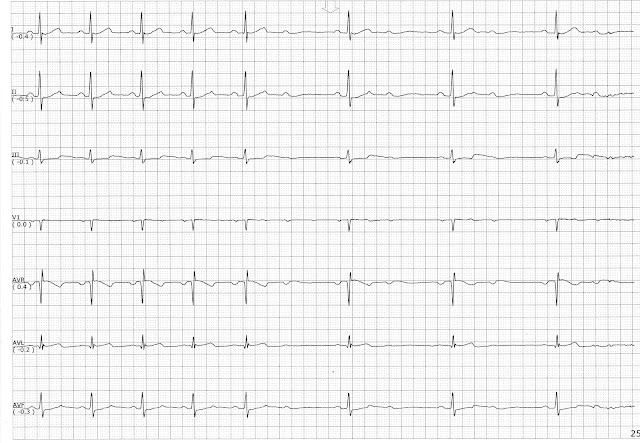
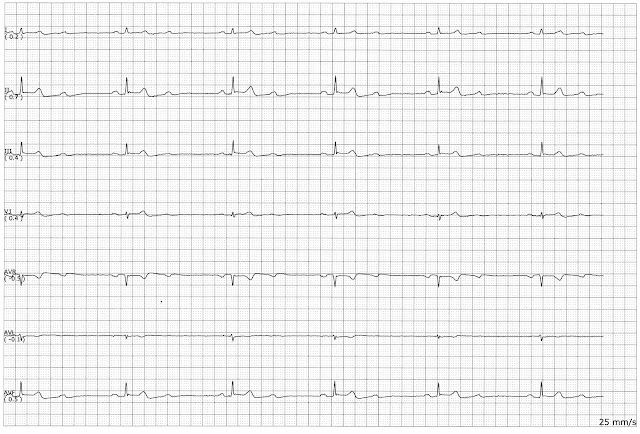
Second degree heart block type II

Image
Second degree heart block type II  

Second degree heart block type I

Image
Second degree heart block type I with 2:1 conduction

Second degree Type I changing to second degree type II

Image
Second degree Type I changing to second degree type II.  This patient switched back and forth between a type I block and a type II block.  

2nd Degree Heart Block Type II

Image
Non-conducted P waves are seen after each QRS complex.  The PR interval on conducted beats have the same measurement.   

2nd Degree Heart Block Type II

Image
This patient was having intermittent episodes of a 2nd degree type II block. 

Practice EKG Rhythm Strips 217

Image
Identify the following rhythms. 1. 2. 3. 4. 5. Answers 1. 2nd degree heart block type II The rhythm is irregular.   The rate is 30/min.  There are upright, uniform P waves present but not all of them are associated with a QRS complex.  A non-conducted P wave follows each QRS complex.  The PR interval is constant on the conducted P waves.  There are two PVCs present, the 1st complex and the 4th complex.   PR:  .36 sec,  QRS:  .12 sec,  QT:  .48 sec.   Interpretation: 2nd degree heart block type II 2. Atrial flutter The rhythm is irregular with a rate of 90.   Flutter waves are present.  No ectopic beats are seen.  PR:---,  QRS:  .12 sec,  QT:.44 sec.   Interpretation:  Atrial flutter. 3. Atrial paced The rhythm is regular with a rate of 75/min.   A small...

Practice EKG Rhythm Strips 204

Image
Identify the following rhythms. 1. 2. 3. 4. 5. Answers 1. Complete heart block The rhythm is regular with a ventricular rate of 35 and an atrial rate of 90/min.   The P waves are upright and uniform but are not associated with a QRS complex.   No ectopic beats are present.   The wide QRS complex suggests a ventricular escape mechanism.    PR:  ---,  QRS:  .12 sec.  QT:  .40 sec. 2. 2nd degree AV block with a PVC The rhythm is irregular with a heart rate of 40/min.   The P waves are upright and uniform.   There are P waves associated with some of the QRS complexes but there are also some dropped complexes.  On the conducted beats, the PR interval is fixed.  A single PVC is present.   PR:  .36 sec.   QRS:  12 sec,   QT:  .56 sec, 3. 1st degree heart block ...

Practice EKG Rhythm Strips 202

Image
Identify the following rhythms. 1. 2. 3. 4. 5. Answers 1. 2nd degree heart block type II The rhythm is irregular with a ventricular rate of 20/min and an atrial rate of  75/min.   The P waves are upright but not all of them are paired with a QRS complex.  No ectopic beats are noted.  The QRS complex is wide.   PR:  .20 sec,  QRS:  .12 sec,  QT:  .64 2. 2nd degree heart block type I The rhythm is irregular with a heart rate of 50/min.   The P waves are upright and uniform.    There is a nonconducted P wave after the 2nd complex.    The PR interval progressively lengthens over successive beats.   PR:  .20/.24/.32sec,  QRS:  .08 sec,  QT:  .40 sec 3. 3rd degree heart block The rhythm is regular with a ventricular rate of 30/min and an atrial rate of 100/min.   The P waves are upright and unifor...

Practice EKG Rhythm Strips 197

Image
Identify the following rhythms. 1. 2. 3. 4. 5. Answers 1. Atrial flutter The rhythm is irregular with a rate of 100/min.   Flutter waves are seen with a varying ration of 2:1 3;1 and 4:1.  No ectopic beats are present.   PR:  ---,  QRS:  .08 sec,  QT:  ---.   Sometimes you cannot clearly pick out the T wave with atrial flutter. 2. NSR with bigeminal PVCs The rhythm  irregular with frequent PVCs.   The rate is 90/min.   The P waves are uniform, upright, and paired with a QRS complex.  There are bigeminal PVCs present.   A compensatory pause follows each PVC.   PR:  .16 sec,  QRS:  .08 sec,  QT:  .28 sec. 3. Junctional rhythm  The rhythm is regular and the heart rate is 50/min.   The P waves are negative and follow the QRS complex.   The QRS complex is wide so this sugge...

Practice EKG Rhythm Strips 181

Image
Identify the following rhythms. 1. 2. 3. 4. 5. Answers 1. 1st degree block The rhythm is regular with a rate of 60/min.   The P waves are upright, uniform and precede the QRS complexes.   The PR interval is prolonged.  No ectopic beats are noted.   PR:  .40 sec,  QRS: .16 sec,  QT:  .48 sec. 2. 2nd degree block type II The rhythm is irregular.   The heart rate is 50/min.   The P wave are upright.   Nonconducted P waves follow the 2nd and 4th complexes.   There is progressive elongation of the PR interval over successive beats.   PR:  .16/.36 sec.  PR:  .12 sec,  QT:  .48 sec. 3. 2nd degree AV block type II The rhythm is regular with a ventricular rate of 42/min.   The P waves are upright and uniform.  Some nonconducted P waves follow each QRS complex.  The PR interval is consistent o...