Posts

Showing posts with the label EKG rhythms

EKG Rhythm Strip

Image
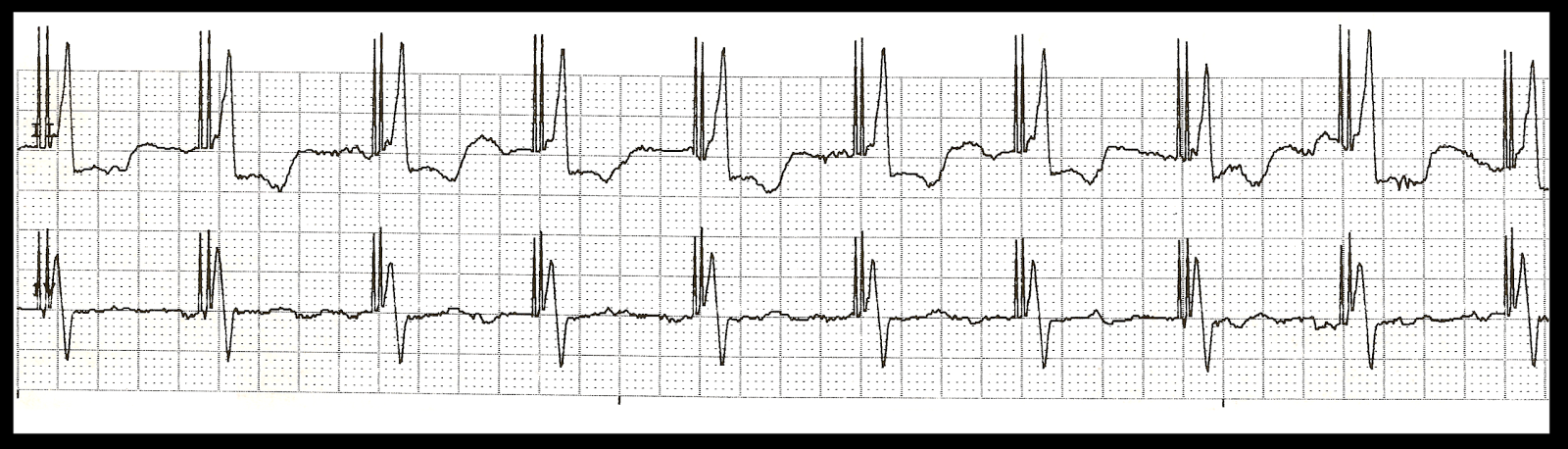
Identify the following rhythm (Click on the image to enlarge it). Biventricular paced beats with an 11 beat run of ventricular tachycardia. The rate of the VT is about 150 bpm.  Complex 4 is a fusion beat and you can see that the pacemaker fired at the same time the ventricular ectopic beat occur. The 5th beat falls on the later half of the T wave so this may have triggered the run of VT.  A fusion beat concludes the run of VT and biventricular pacing resumes.  

EKG Rhythm Strip

Image
Identify the following rhythm. (Click on the image to enlarge) Atrial fibrillation with ventricular escape beats.  The underlying rhythm is atrial fibrillation.  Beats  4, 5, and 6 occur late in the cardiac cycle. The morphology of the QRS complex is much wider than the QRS complexes of beats 1, 2, 3, and 7. The R - R interval between beats 3 and 4 is about 37 small boxes, this corresponds to a rate of about 40 beats/min.  Since the inherent rate of the ventricles is 20 - 40 bpm, complex 4 falls within the upper limits of an escape beat of ventricular origin. Complexes 5 and 6 occur at the same rate.  

EKG Rhythm Strip

Image
Identify the following rhythm. The answer is sinus bradycardia with sinus arrest. 

EKG rhythm Strips

Image
Identify the following rhythm. The answer is: Atrial fibrillation with aberrantly conducted beats.  The rsR' pattern in lead V1 favors aberrancy.  In his book ACLS 2013 Arrhythmias, Dr Ken Grauer states that when there is a RBBB morphology in the V1 lead with a tall R' wave and an S wave that descends below the baseline then the complex favors abberrancy. 

Practice EKG Strips 389

Image
Identify the following rhythms. 1. a. Sinus tachycardia b. Supraventricular tachycardia c. Ventricular tachycardia d. Junctional tachycardia 2. a. NSR with sinus arrest b. Sinus arrhythmia c. Complete heart block d. Mobitz II 3. a. Sinus bradycardia with 1st degree block b. Junctional rhythm with 1st degree block c. Complete heart block with 1st degree block d. Normal sinus rhythm with 1st degree block 4. a. Complete heart block b. Junctional rhythm c. Agonal rhythm d. Ventricular standstill 5. a. Normal sinus rhythm b. Accelerated idioventricular rhythm c. Accelerated junctional d. Atrial fibrillation with controlled ventricular response Answers 1.  b. Supraventricular tachycardia.   The rate is fast so the P waves may be buried in the T waves or not be present at all. So we cannot say with certainty that it is either answer A or D....

Practice EKG Strips 345

Image
Identify the following rhythms. 1. a. Atrial paced b. Biventricular paced c. Dual paced d. Ventricular paced 2. a. Sinus bradycardia with inverted T waves b. Normal sinus rhythm with inverted T waves c. Junctional rhythm with inverted T waves d. First degree block with inverted T waves 3. a. Normal sinus rhythm b. Sinus bradycardia c. Sinus arrhythmia d. Sinus arrest 4. a. Sinus rhythm with first degree block b. Sinus bradycardia with first degree block c. Sinus arrest with first degree block d. Sinus tachycardia with first degree block 5. a. Normal sinus rhythm b. Accelerated junctional rhythm c. Accelerated Idioventricular rhythm d.Ventricular tachycardia Answers 1. b. Biventricular paced 2. b. Normal sinus rhythm with inverted T waves 3. c. Sinus arrhythmia 4. b. Sinus bradycardia with first degree block 5. a. Normal sinus rhythm

Practice EKG Strips 344

Image
Identify the following rhythms. 1. a. Atrial flutter b. Atrial fibrillation c. Atrial tachycardia d. 2nd degree AV block type II 2. a. Supraventricular tachycardia b. Ventricular tachycardia c. Sinus tachycardia d. Atrial tachycardia 3. a. Supraventricular tachycardia changing to VT b. Ventricular tachycardia changing to VF c. Ventricular fibrillation changing to Tdp d. Sinus tachycardia changing to AIVR 4. a. Normal sinus rhythm with sinus arrest b. Sinus arrhythmia with sinus arrest c. Atrial fibrillation with sinus arrest d. Complete heart block 5. a. Sinus arrhythmia with unifocal PVCs b. Sinus rhythm with dropped PACs and ventricular escape beats c. NSR with sinus arrest with unifocal PVCs d. 2nd degree AV block type II with unifocal PVCs Answers 1. a. Atrial flutter 2. b. Ventricular tachycardia 3. a. Supraventricular tachycardia changing to VT 4. c. Atrial fibrillation with sinus arrest 5. b. Sinus...

Practice EKG Strips 343

Image
Identify the following rhythms? 1. a. First degree block b. Second degree block type I c. Second degree block type II d. Complete heart block 2. a. Atrial fibrillation b. Ventricular fibrillation c. NSR with some artifact d. Multifocal atrial tachycardia 3. a. First degree block b. Second degree block type I c. Second degree block type II d. Complete heart block 4. a. First degree block b. Second degree block type I c. Second degree block type II d. Complete heart block 5. a. Sinus arrest b. Agonal rhythm c. Junctional rhythm d. Complete heart block Answers 1. a. First degree block 2. c. NSR with some artifact 3. c. Second degree block type II 4. b. Second degree block type I 5. b. Agonal rhythm

Practice EKG Strips 342

Image
Identify the following rhythms. 1. a. Junctional rhythm b. Complete heart block c. Idioventricular rhythm d. Sinus bradycardia 2. a. Normal sinus rhythm with multifocal PVCs b. Normal sinus rhythm with unifocal PVCs c. Normal sinus rhythm with bigeminal PVCs d. Normal sinus rhythm with trigeminal PVCs 3. a. Atrial paced b. Biventricular paced c. Dual paced d. Ventricular paced 4. a. Normal sinus rhythm with ST depression b. Sinus bradycardia with ST depression c. Junctional rhythm with ST depression d. Accelerated Idioventricular rhythm with ST depression 5. a. Atrial tachycardia b. Multifocal atrial tachycardia c. Supraventricular tachycardia d. Ventricular tachycardia Answers 1. b. Complete heart block. The ventricular rate is around 38 and the atrial rate around 60 bpm. The P waves and the QRS complexes are not paired up. 2. d. Normal sinus rhythm with trigeminal PVCs 3. c. Dual paced with biventri...

Practice EKG Strips 341

Image
Identify the following rhythm. 1. a. Accelerated Idioventricular rhythm b. Idioventricular rhythm c. Accelerated junctional rhythm d. Junctional rhythm 2. a. Atrial paced b. AV paced c. Biventricular paced d. Ventricular paced 3. a. Multifocal atrial tachycardia b. Polymorphic ventricular tachycardia c. Supraventricular tachycardia d. Sinus tachycardia 4. a. Sinus tachycardia b. Supraventricular tachycardia c. Ventricular tachycardia d. Junctional tachycardia 5. a. Normal sinus rhythm with PACs b. Normal sinus rhythm with bigeminal PACs c. Sinus rhythm with frequent pauses d. NSR with PJCs Answers 1. c. Accelerated junctional rhythm 2. d. Ventricular paced 3. b. Polymorphic ventricular tachycardia 4. a. Sinus tachycardia 5. a. Normal sinus rhythm with PACs

Practice EKG Strips 340

Image
Identify the following rhythms. 1. a. Sinus bradycardia b. Atrial fibrillation c. Junctional rhythm d. Idioventricular rhythm 2. a. Atrial flutter b. Atrial paced c. Atrial fibrillation d. Atrial tachycardia 3. a. Sinus bradycardia b. Complete heart block c. Junctional rhythm d. Atrial fibrillation 4. a. Sinus bradycardia b. Atrial fibrillation c. Junctional rhythm d. Idioventricular rhythm 5. a. First degree block with a PAC b. Atrial flutter with a PVC c. Sinus arrhythmia d. Idioventricular rhythm Answers 1. b. Atrial fibrillation 2. a. Atrial flutter 3. c. Junctional rhythm 4. d. Idioventricular rhythm 5. a. First degree block with a PAC

Practice EKG Strips 339

Image
Identify the following rhythms. 1. a. Atrial fibrillation with RVR b. Atrial tachycardia c. Multifocal atrial tachycardia d. Tachycardia with sinus arrhythmia 2. a. Supraventricular tachycardia changing to VT b. Ventricular tachycardia changing to VF c. Sinus tachycardia changing to OMG d. Atrial fibrillation with RVR changing to SVT 3. a.  Sinus bradycardia with trigeminal PACs b.  Sinus bradycardia with trigeminal PJCs c.  Sinus bradycardia with trigeminal PVCs d.  2nd degree heart block type I 4. a.  Sinus rhythm with multifocal PVCs b.  Sinus rhythm with unifocal PVCs c. Sinus rhythm with polymorphic VT d. Sinus rhythm with quadrigeminal PVCs 5. a.  Sinus bradycardia b. Junctional rhythm c. Complete heart block d. Atrial fibrillation Answers 1. c. Multifocal atrial tachycardia 2. b. Ventricular tachycardia changing to...

Practice EKG Strips 338

Image
Identify the following rhythm. 1. a. Sinus bradycardia with multifocal PVCs b. Sinus bradycardia with unifocal PVCs c. Sinus bradycardia with bigeminal PVCs d. Sinus bradycardia with trigeminal PVCs 2. a. Atrial flutter with run of VT b. Atrial flutter with run of AIVR c. Atrial flutter with run of ST d. Atrial flutter with run of SVT 3. a. Sinus arrhythmia b. Mobitz II c. Atrial flutter d. Wenckebach 4. a. Agonal rhythm b. Accelerated Idioventricular rhythm c. Complete heart block d. Idioventricular rhythm 5. a. NSR changing to VT b. NSR changing to SVT c. NSR changing to VF d. NSR changing to TDP Answers 1.  b. Sinus bradycardia with unifocal PVCs 2.  b. Atrial flutter with run of AIVR 3.  b. Mobitz II 4.  b. Accelerated Idioventricular rhythm 5.  a. NSR changing to VT

Practice EKG Strips 338

Image
Identify the following rhythms. 1. a. Sinus bradycardia with PACs b. Sinus arrhythmia c. Sinus rhythm with PJCs d. Sinus arrest 2. a. NSR with multifocal PVCs b. NSR with a PVCs triplet c. NSR with trigeminy d. NSR with polymorphic PVCs 3. a. Atrial paced b. AV paced c. Biventricular paced d. Ventricular paced 4. a. Supraventricular tachycardia b. Sinus tachycardia c. Ventricular tachycardia d. Multifocal atrial tachycardia 5. a. Sinus bradycardia b. Junctional rhythm c. Complete heart block d. Idioventricular rhythm Answers 1.  a. Sinus bradycardia with PACs 2.  c. NSR with trigeminy 3.  d. Ventricular paced 4.  c. Ventricular tachycardia 5.  c. Complete heart block. No association between the P waves and the QRS complexes: note the changing PR intervals. The 4th complex may be a PVC giving this heart block it's irregular looking rhythm.